Context and objective
The Bridge Curse: Road to Salvation is a Taiwanese first-person horror game set in a cursed university. It was my first professional project directly related to video games: at Catness Game Studios I took part in its port to five platforms.
My job was to supervise and fix the graphics issues that came up during the port, keep each platform’s performance within its target, implement the English dub and support other programming tasks of the port.
Per-platform targets
| Platform | Resolution | Framerate |
|---|---|---|
| PS5 · Xbox Series X|S | 4K | 60 FPS |
| PS4 · Xbox One | 1080p | 60 FPS |
| Nintendo Switch | 1080p / 720p | 30 FPS |
The same content had to cover everything from current consoles to the Switch, with almost an order of magnitude of difference in power between the two extremes.
Optimization
Although the game has no large open spaces, it did have performance problems, especially on eighth-generation consoles and, above all, on Switch. The source was the environments themselves, highly detailed, piling up many objects and dynamic lights, many of them casting shadows.
Most of the changes fell into three categories:
- Reducing geometry in the scene.
- Reducing draw calls in very specific locations and camera angles where visible objects piled up.
- Making expensive per-pixel materials cheaper: the long hair typical of Asian horror, plants and fleshy surfaces, all materials with transparency, layers or subsurface effects whose cost spikes when they cover a large part of the screen.

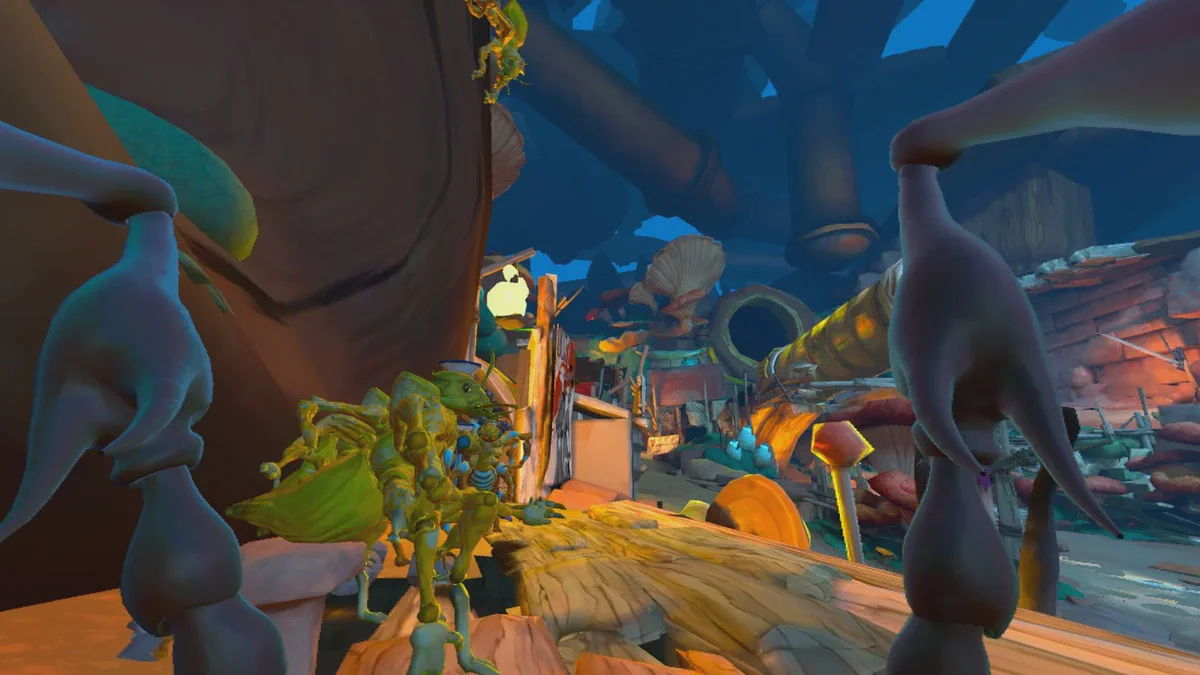
The highly detailed interiors piled up objects and dynamic lights.
The hair shader on PlayStation
On PlayStation, the characters’ hair showed exaggerated scattering: when the light direction aligned with the view vector, the hair was over-lit, as if it glowed from within.
Unreal’s hair shading model is based on the Marschner model, which breaks the light passing through a fiber into several lobes: surface reflection, transmission through the fiber and transmission with internal reflection. Transmission is responsible for hair’s characteristic backlit glow, and its intensity spikes precisely when the light and view tend to align.
The fix consisted of adding an attenuation factor to the engine’s hair shader that reduces scattering as both vectors tend to become parallel. Schematically:
// Illustrative sketch of the idea, not the engine's original code
float alignment   = abs(dot(L, V));                         // → 1 when light and view align
float attenuation = lerp(1.0, ScatterAttenuationMin,
                         pow(alignment, ScatterAttenuationSharpness));
Transmission *= attenuation;
The shape of the curve leaves the look of the hair intact at most angles and only acts on the problematic range.
Z-fighting on Switch
On Switch, some posters hanging on the walls flickered against them when seen from a distance: classic z-fighting, two surfaces so close that the depth buffer cannot tell which one is in front.
The cause was depth precision. Switch used a 24-bit depth buffer by default, compared to 32 bits on other platforms. In a perspective projection, precision is not distributed uniformly: it is concentrated near the camera and degrades with distance. A 24-bit buffer offers only about 16.7 million values; at a certain distance, the poster and the wall fall into the same value.
Since the problem appeared in practically every level, fixing it poster by poster (separating them from the wall or offsetting their vertices in the material) was not viable. I modified the engine to use a 32-bit floating-point depth buffer on Switch. Combined with the reversed depth (reversed-Z) that Unreal uses by default, the precision of a 32-bit floating-point buffer is distributed much more uniformly across distance.
The change completely eliminated the z-fighting and had no measurable framerate cost.
English dubbing
The game had original Chinese voice acting and the client wanted to add an English dub. The complication: due to communication issues, the English tracks were not recorded with the same duration as the originals. Since the sequences are built on Unreal’s Sequencer, each track lasts as long as its section, so hundreds of audio sections across all of the game’s sequences would have had to be adjusted by hand.
Instead, I solved it programmatically:
- The English tracks followed Unreal’s asset localization system: a localized asset is stored with the same name and path inside its language folder, and the engine swaps it automatically based on the active culture.
- I modified the engine’s sequence evaluator so that, when evaluating an audio section, it replaced the audio with its localized version and adjusted the section’s duration in real time to the length of the English track.
- The adjustment respects the timing of the original game’s lines and subtitles, so each line still starts at its proper moment.

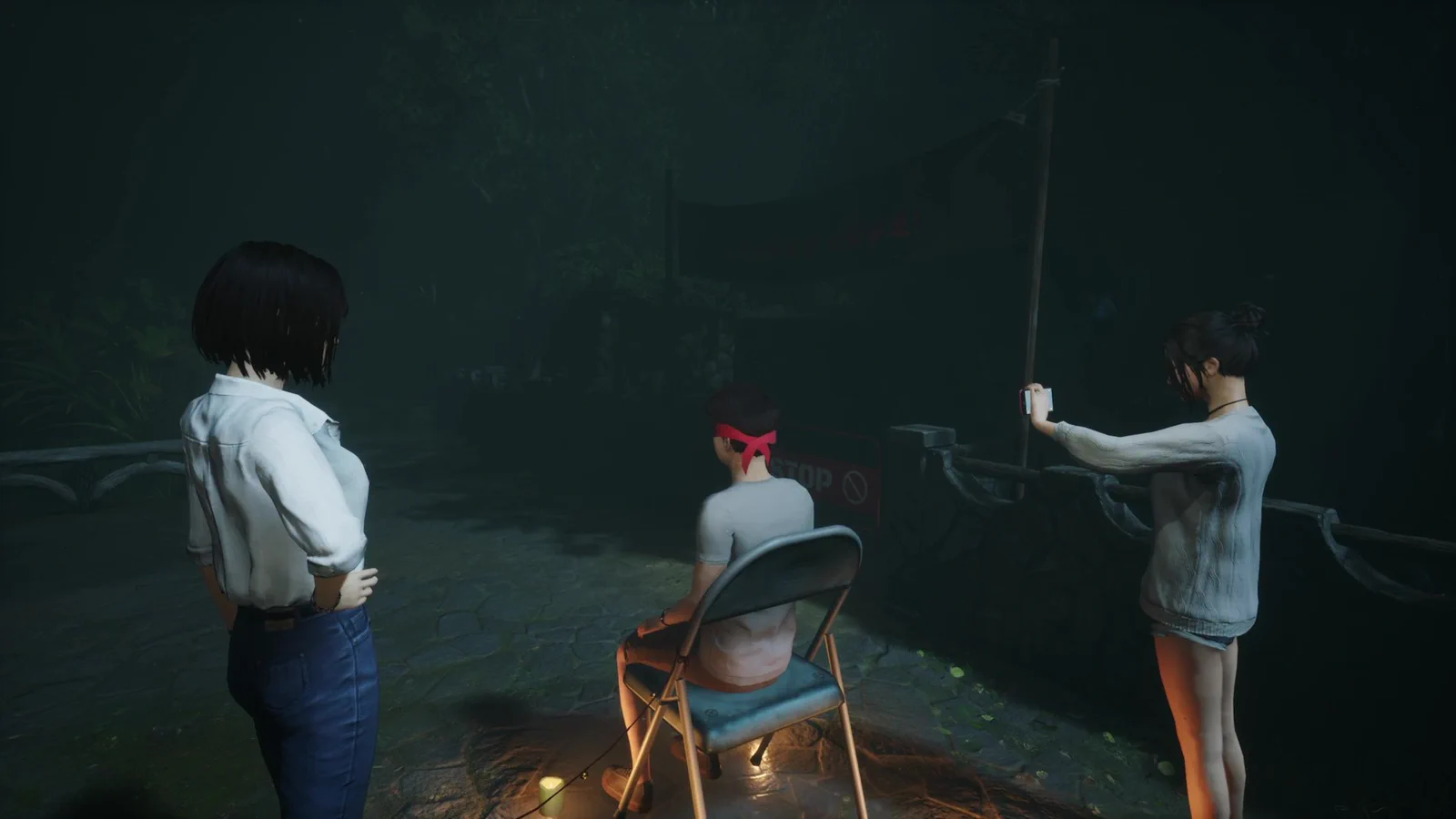
Sequence near the beginning of the game [Xbox Series].
Automating it saved adjusting each audio section by hand, and any track corrected later would fit on its own, without touching the sequences again.
What I learned
The dubbing system and the hair and depth buffer fixes were the first times I dove deep into Unreal Engine’s code to modify it. I learned to find my way around a huge codebase and to turn specific graphics problems into localized engine changes. I also discovered that, with patience, a tool as complex as Unreal can be understood and adapted, and how much that expands what you can solve.
Demonstration
Gameplay of the game on PS5.